

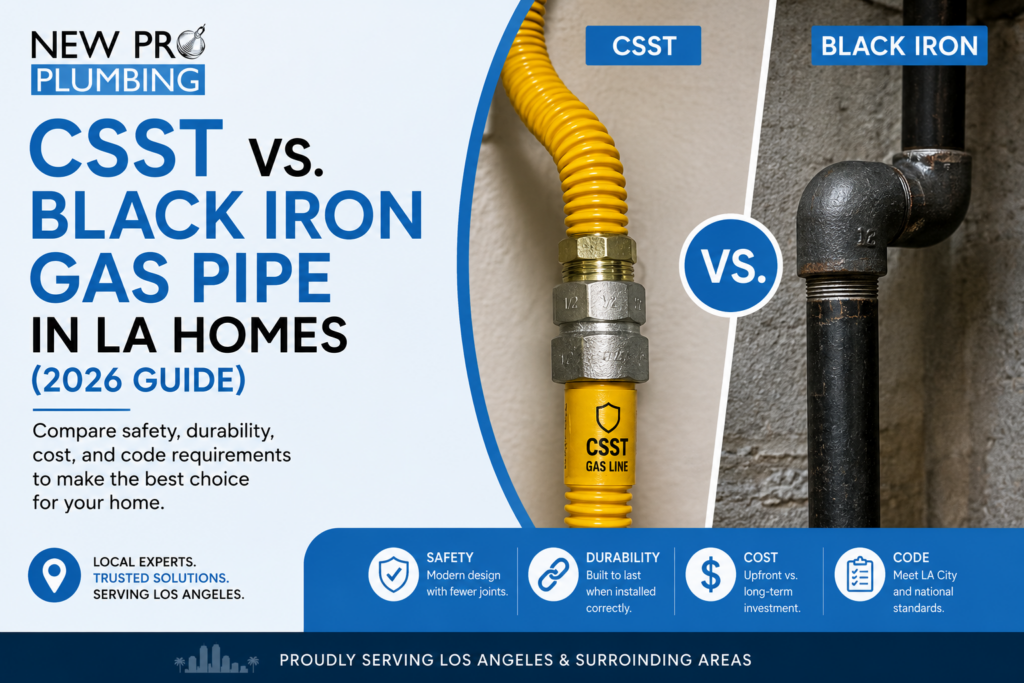





If a plumber has told you that your gas line needs to be replaced or extended, you have probably heard one of two material recommendations: traditional black iron pipe or corrugated stainless steel tubing (CSST). Both are code-approved in Los Angeles, both have been used in residential construction for decades, and both have their place. The right choice depends on the specific job, the layout of your home, and which strengths matter most to you. This guide walks through what each material is, where each one fits, and what every LA homeowner should know before authorizing a gas line install or replacement.
What Is Black Iron Gas Pipe?
Black iron pipe is the traditional material for residential gas distribution. It is made of carbon steel with a dark, non-galvanized finish, joined together with threaded connections sealed with pipe dope or yellow PTFE tape. Black iron has been the standard in American residential construction for over a century and remains the most common gas pipe material in older Los Angeles homes.
The pipe comes in rigid sections (typically 1/2 inch, 3/4 inch, or 1 inch nominal diameter for residential use) and is cut and threaded on-site to fit the run. Fittings include elbows, tees, couplings, unions, and reducers.
What Is CSST?
CSST stands for corrugated stainless steel tubing. It is a flexible, thin-walled stainless steel tubing with a continuous corrugated profile, jacketed in yellow or black polyethylene for protection and identification. CSST was developed in Japan in the late 1980s and approved for residential use in the United States in the 1990s.
Unlike black iron, CSST is flexible and can be bent by hand to route around obstacles. It uses specialized mechanical fittings that compress the corrugated tubing against a sealing ring. The flexibility is its biggest practical advantage and its most distinguishing feature.
Cost Comparison
In Los Angeles in 2026, typical pricing breaks down like this:
Black iron material cost: $3 to $6 per linear foot, plus fittings.
CSST material cost: $4 to $9 per linear foot, plus specialized fittings.
Black iron labor: Slower to install due to cutting, threading, and rigid routing. A typical residential gas line run takes 30 to 50 percent more labor hours than the equivalent CSST run.
CSST labor: Faster to install in finished spaces, attics, and tight retrofits where flexibility matters.
For straight, accessible runs (basement to a single appliance, for example), black iron is usually cheaper installed. For complex routing through finished ceilings, attics, or around obstacles, CSST often comes out cheaper installed because of labor savings.
Full pricing details for gas line work in LA are covered in our gas line repair cost guide.
Where Black Iron Wins
Long Straight Runs
For a long straight gas line run in an accessible location (basement, garage, crawlspace), black iron is hard to beat. Material cost is lower, and the rigid pipe holds its alignment well without additional support.
High-Pressure Applications
Black iron is rated for higher operating pressures than residential CSST. For commercial work or specialized residential applications, black iron is often the only option.
Durability
Properly installed black iron has a service life of 75 to 100 years in normal residential conditions. It is robust against physical damage and does not degrade from sunlight or environmental exposure.
Familiarity
Every licensed plumber in Los Angeles is trained on black iron from day one. Repairs, modifications, and additions are straightforward for any qualified contractor. CSST requires specific manufacturer training that not every plumber holds.
Where CSST Wins
Retrofit Work in Finished Spaces
This is CSST’s strongest case. Adding a gas line to a finished home (for a new range, gas fireplace, outdoor grill, or generator) often requires routing through attics, between joists, and around obstacles where rigid pipe is impractical. CSST bends around corners and snakes through tight spaces with minimal demolition.
Earthquake Performance
Los Angeles is on multiple active fault lines, and earthquake performance is a meaningful consideration. The California Geological Survey publishes seismic risk information for residential construction. CSST’s flexibility allows it to absorb seismic movement that would crack rigid black iron at threaded joints. After major earthquakes, CSST gas systems have generally performed better than older black iron systems in terms of leak occurrence.
Faster Installation
For complex residential jobs, CSST installs significantly faster than black iron, which translates to lower labor costs and shorter disruption for the homeowner.
Fewer Joints
A run of CSST has dramatically fewer connection points than the equivalent run of black iron. Each joint is a potential leak point over time, so fewer joints means fewer long-term failure risks.
The Lightning and Bonding Concern
CSST has one well-known drawback that every homeowner should understand: its thin stainless steel walls are vulnerable to damage from nearby lightning strikes. Direct or nearby lightning can induce electrical current in the building’s metal systems, and CSST can develop pinhole leaks where the current arcs to or from the tubing.
The solution is mandatory bonding. CSST must be electrically bonded to the home’s grounding system with a #6 AWG copper wire at a specified location near where the CSST enters the home. Properly bonded CSST has dramatically reduced lightning-related failure rates. The National Fire Protection Association sets the bonding standards in NFPA 54 that licensed plumbers follow.
Black iron is not subject to the same vulnerability because its wall thickness is much greater.
In Los Angeles, where lightning is relatively rare compared to the Midwest or Southeast, the practical risk is lower than in many parts of the country. But bonding is still required by code on all CSST installations, and it should be inspected as part of any home purchase that has CSST present.
Code and Permitting in Los Angeles
Both materials are approved for residential gas distribution in Los Angeles under the California Plumbing Code. All gas line work in the city requires a permit through the Los Angeles Department of Building and Safety, regardless of which material is used. Inspections at the appropriate stages ensure the installation meets code, including:
- Proper pipe sizing for the appliance load
- Correct fittings and connection methods
- Required shutoffs at each appliance
- Pressure testing before backfilling or covering
- Bonding (for CSST)
- Manufacturer-specific installation requirements (for CSST)
Unpermitted gas work is illegal regardless of pipe material and creates liability for the homeowner. The federal Pipeline and Hazardous Materials Safety Administration publishes safety standards that licensed contractors are required to follow.
What’s in Your Home Right Now?
For most LA homes:
- Built before 1990: almost certainly black iron, possibly with some galvanized steel sections in very old homes
- Built 1990 to 2005: usually black iron, with some CSST in custom or premium builds
- Built 2005 to present: a mix, with CSST becoming more common in production builds
- Renovated since 2000: often has CSST sections added to existing black iron systems
If you do not know what your gas piping is, a licensed plumber can identify it in a few minutes. CSST is distinctive: flexible, yellow-jacketed (or black-jacketed for outdoor sections), and obviously different from rigid black pipe.
What If You Have Galvanized Steel?
A small number of older Los Angeles homes still have galvanized steel gas piping, which was used in some early 20th century construction before black iron became standard. Galvanized steel is not approved for gas distribution in modern code, and any home still on it should have the gas piping upgraded. We covered the warning signs in our post on warning signs of an underground gas line problem and the broader topic on our gas line inspection page.
Which Should You Choose?
The honest answer is that for most LA homeowners, the choice should be made by your licensed plumber based on the specific job. Generally:
Choose black iron for: New construction with straight runs, basement-to-appliance installs in unfinished spaces, long-distance runs in garages or utility areas, commercial applications, or any job where material cost is the primary concern.
Choose CSST for: Retrofits in finished homes, complex routing through attics or floor joists, seismic-sensitive installations, jobs where installation speed matters, or new appliance branches where the existing system is black iron and connecting through CSST simplifies the routing.
Choose a hybrid approach for: Most real-world residential jobs in LA, where black iron handles the main distribution and CSST handles the final connection to appliances.
Frequently Asked Questions
Is CSST safe?
Yes, when properly installed and bonded. Bonding is non-negotiable and must be inspected as part of the permit process.
Will CSST devalue my home?
Properly installed and bonded CSST does not affect home value. Some buyers and inspectors look for confirmation that bonding is in place, which a licensed plumber can verify.
Can I mix CSST and black iron in the same system?
Yes, with appropriate transition fittings. This is the most common configuration in retrofit work.
How long does each material last?
Black iron typically lasts 75 to 100 years. CSST is rated for similar lifespans when properly installed and protected from physical damage.
Do I need to upgrade my existing black iron pipe?
Not unless it shows signs of corrosion, failure, or has been damaged. Properly maintained black iron systems can last well over a century.
Get a Professional Recommendation
If you are planning a gas line installation, repair, or replacement, contact New Pro Plumbing for a licensed assessment and a written quote in Los Angeles. We work with both materials and will recommend whichever fits your specific job best, with full permit and inspection handling.